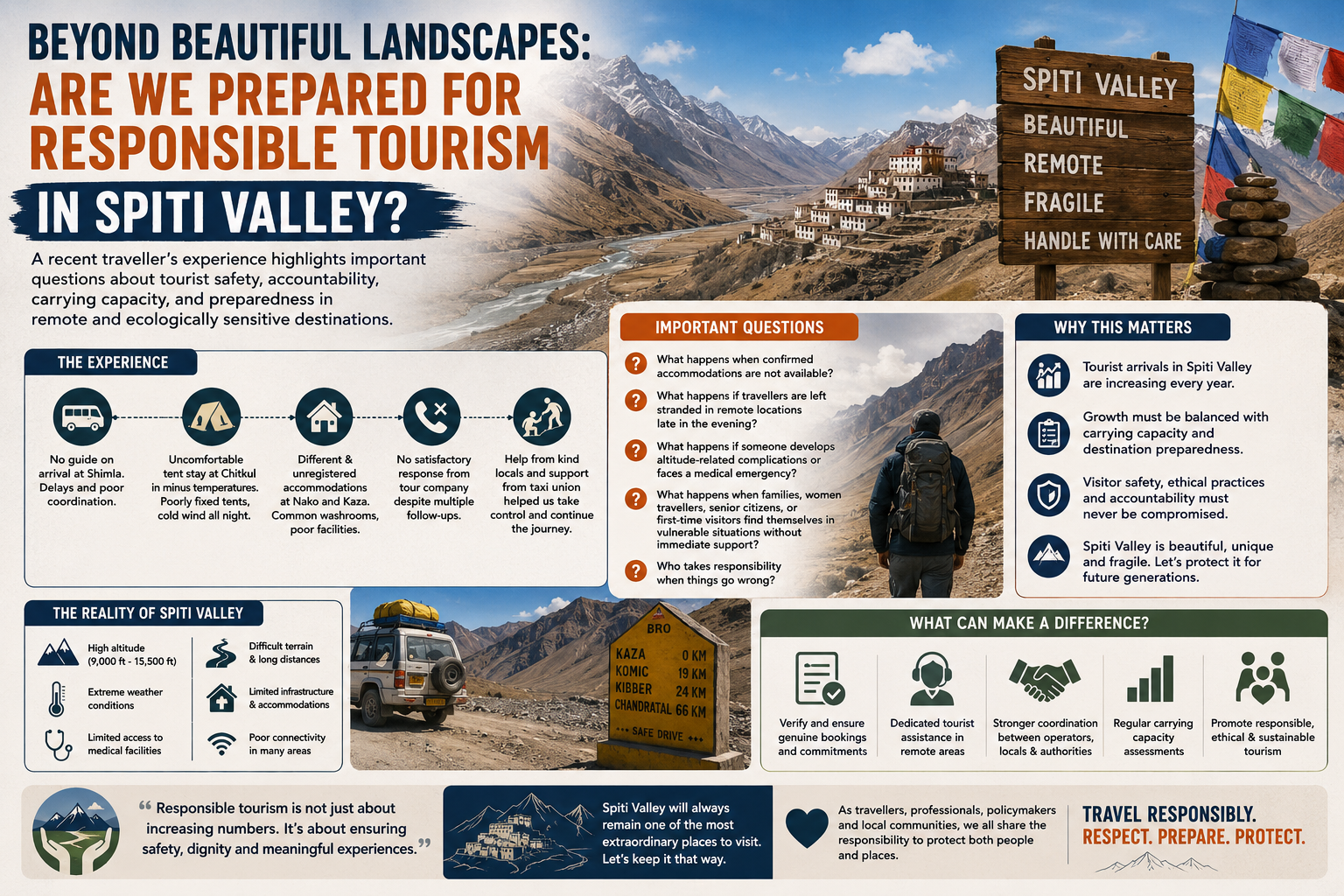
Beyond Beautiful Landscapes: Are We Prepared for Responsible Tourism in Spiti Valley?
A few days ago, I received a call from an old friend. His voice carried concern. His brother-in-law, Mr. Saurabh Jha, along with three friends, was travelling through Spiti Valley in Himachal Pradesh and was facing a situation that no traveller expects during a holiday.

Fortunately, with the support of local residents and community stakeholders, the group was eventually able to reorganise their journey and continue exploring the beautiful landscapes of Spiti Valley.While speaking to Saurabh over the following days, I realised that this was not merely a story about unpleasant travel experience. It raised broader questions about tourist safety, accountability, carrying capacity, and preparedness in remote destinations that are witnessing a significant increase in visitor numbers.
The following account is based on Saurabh's own experience and has been reviewed by him prior to publication.
A few days ago, I found myself in a situation that no traveller hopes to experience during a holiday.
Along with three friends, I was travelling through Spiti Valley in Himachal Pradesh. The trip had been booked through a travel company, and specific accommodations and services had been confirmed before our departure. However, from the very beginning of the journey, the reality on the ground appeared to be quite different from what had been promised.

As the journey progressed, we repeatedly tried to contact the representatives of the travel company. Initially, we attempted to coordinate with the designated tour leader. Unfortunately, the responses received were neither satisfactory nor solution-oriented. We then tried reaching out to the operations team, hoping that they would intervene and resolve the situation. However, despite multiple attempts, meaningful support was not forthcoming. Still we relied on the tour company and reached Kaza.
While searching for accommodation, we met a local resident who understood our predicament and extended his support. Through his guidance and assistance, we were able to secure a much better place to stay for the night.
The next morning, determined not to let the remainder of the trip be ruined, we approached the local taxi union. We discussed our concerns, reviewed our upcoming itinerary, and arranged independent transportation for the remaining part of the journey. Taking control of the situation ourselves gave us confidence that the rest of the trip could proceed more smoothly.
Although the immediate issues were eventually addressed, the experience left us with several important questions.
Spiti Valley is not a conventional tourist destination. It is a high-altitude cold desert characterised by difficult terrain, limited infrastructure, extreme weather conditions, and restricted access to emergency services. Travelling in such regions requires meticulous planning and responsible execution.
What happens when confirmed accommodations are not actually available?
What happens if travellers are left stranded in remote locations late in the evening?
What happens if someone develops altitude-related complications or faces a medical emergency?
What happens when families, women travellers, senior citizens, or first-time visitors find themselves in vulnerable situations without immediate support?
And perhaps the most important question of all: who takes responsibility when things go wrong?
This is not merely about one group’s unpleasant experience. It is about recognising the challenges that accompany the growing popularity of destinations like Spiti Valley.
Over the past few years, tourist arrivals in the region have increased significantly. While this growth has undoubtedly benefited local communities and businesses, it also raises important questions regarding carrying capacity and destination preparedness.
Are there adequate systems in place to ensure that accommodation and travel commitments made to tourists are genuine and verifiable?
Should there be dedicated tourist assistance mechanisms in remote destinations to support travellers during emergencies?
Do we need stronger coordination between travel operators, local stakeholders, and authorities to ensure that visitor safety is never compromised?
Should there be periodic assessments of carrying capacity to prevent tourism infrastructure from becoming overwhelmed?
These questions deserve thoughtful discussion.
Despite the challenges we faced, this experience also reminded us of the kindness and hospitality of the people of Himachal Pradesh. It was the support of local individuals and community stakeholders that ultimately helped us regain confidence and continue our journey smoothly in the remote location of komik,kibber and chandratal.
The purpose of sharing this experience is not to discourage tourism in Spiti Valley. On the contrary, Spiti remains one of the most beautiful,unique and dream destinations in the world. However, as tourism continues to expand into ecologically sensitive and geographically challenging regions, preparedness and accountability must grow alongside it.
Responsible tourism cannot focus solely on increasing visitor numbers. It must also prioritise visitor safety, ethical business practices, realistic planning, and effective support systems.
Only then can destinations like Spiti Valley continue to offer experiences that are memorable for all the right reasons.
_______________________________________________
As tourism professionals, policymakers, local communities, and travellers, we all share a collective responsibility to ensure that tourism growth does not come at the cost of visitor safety and destination integrity.
Spiti Valley remains one of the most extraordinary places to visit, and the purpose of sharing this experience is not to discourage travel, but to encourage dialogue. If experiences such as these can help strengthen systems, improve accountability, and enhance preparedness in remote destinations, then perhaps they can contribute positively towards the future of tourism in Himachal Pradesh.
— Dr. Naveen Gupta