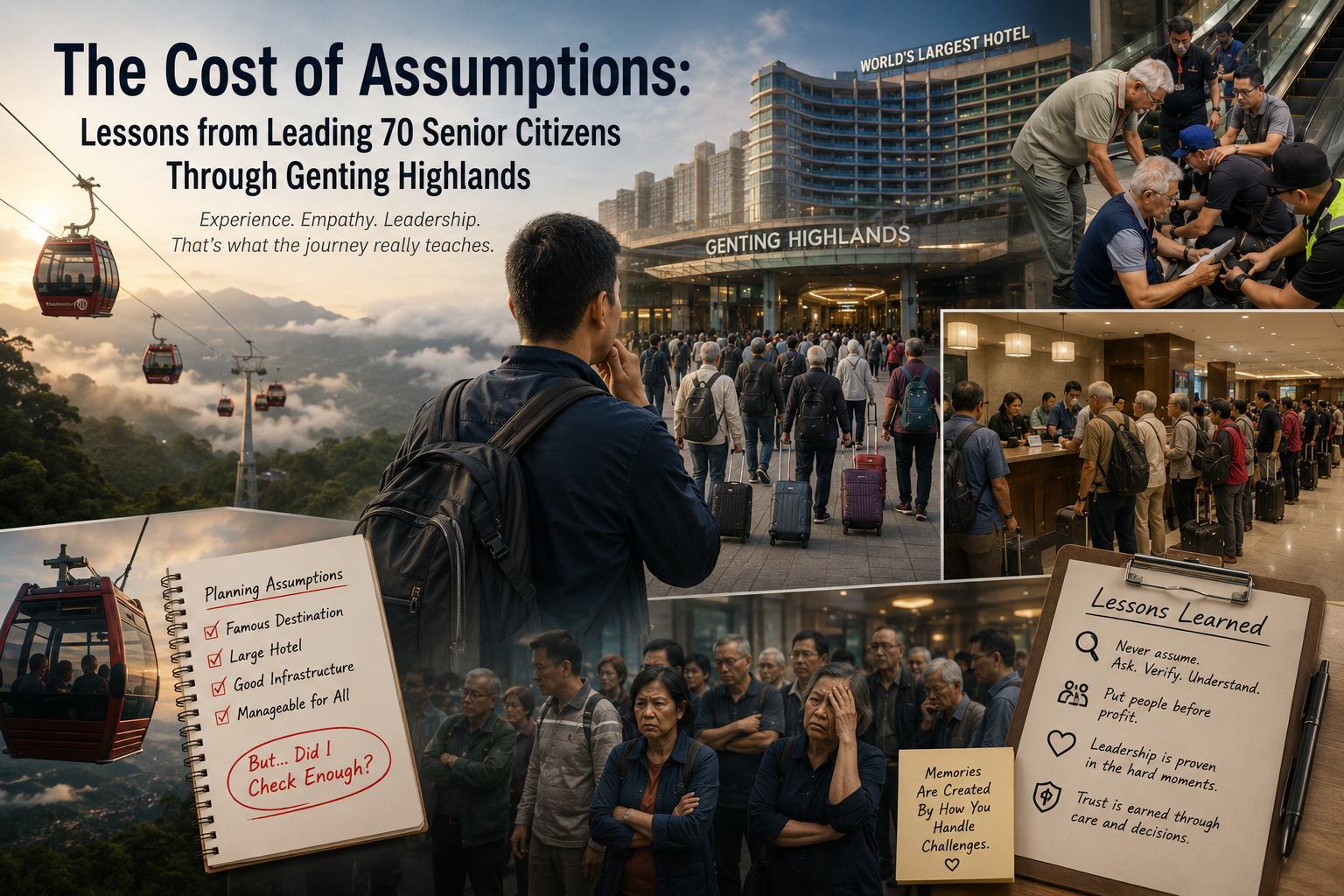
The Cost of Assumptions: Lessons from Leading 70 Senior Citizens Through Genting Highlands
Travel often looks perfect in photographs. Behind every smiling group picture, however, there are countless decisions, responsibilities, and moments of uncertainty that travellers rarely see.
A few months ago, I had the privilege of leading a group of around 70 senior citizens on a seven-day journey across Malaysia, covering Langkawi, Genting Highlands, and Kuala Lumpur. What began as one of our most enjoyable tours soon turned into one of the most challenging experiences of my professional life.
The first leg of the journey in Langkawi was nothing short of wonderful. Our guests loved their stay at The Westin Langkawi. The island-hopping tours, beautiful surroundings, delicious meals, and relaxed atmosphere created exactly the kind of memories we had hoped for.
Then came Genting Highlands.
The cable car ride itself was exciting. Guests admired the impressive infrastructure and looked forward to experiencing one of Malaysia’s most famous hill destinations.
What we had not anticipated was what awaited us after reaching the top.
Our coaches arrived separately at a designated parking area, and guests had to collect their luggage themselves. The distance from the cable car drop-off point to the coach parking area was approximately two to two-and-a-half kilometres within the Genting complex.
For seventy senior citizens carrying luggage, it became an unexpected challenge.
Despite the long walk, our guests remained positive. They appreciated the architecture, shopping areas, escalator systems, and international atmosphere of Genting Highlands.
Then, unfortunately, an accident occurred.
Two members of our group lost their balance while using an escalator and suffered minor injuries to their elbows, knees, and hands. The security personnel reacted immediately and stopped the escalator. Fellow travellers rushed to help, first aid was provided, and thankfully both guests were out of danger.
The wait times became exhausting.
People with luggage crowded the lifts, movement slowed considerably, and frustration naturally began to build.
I stayed back until the very end, ensuring every guest had collected their luggage and was on their way towards the hotel reception.
By the time I finally reached the reception area, I expected most guests to have already checked in and settled into their rooms.
Instead, I walked into what felt like a crowded railway booking counter.
Although our reservation had been fully paid and confirmed in advance, the rooms were not ready. It was around 4:30 p.m.
Unfortunately, no clear answers were available.
“We are preparing the rooms.”
That was all I kept hearing.
Minutes turned into hours.
At 5:30 p.m., the guests had understandably become restless. They could see my efforts, but their exhaustion was real.
Finally, around 6:40 p.m., room keys began to arrive.
Relief quickly turned into another challenge.
The room allocation had become random. Although we had submitted a detailed rooming list, guests received rooms that did not match the original allocations. Even the Wi-Fi passwords were linked to surnames associated with the original room assignments, creating further confusion.
Then I entered one of the rooms myself.
I was speechless.
I had been informed earlier that the rooms would be small.
I had ignored that information.
I assumed “small” simply meant compact.
What I found instead were extremely tiny rooms with minimal space and no real sense of comfort, especially for senior travellers who had already had an exhausting day.
Not because something had gone wrong.
But because I had ignored a warning sign simply because the hotel carried the attraction of being one of the world’s largest hotels.
Guests began expressing their disappointment. Some were upset. Some were angry.
As a tour leader, those moments are among the hardest.
You cannot disappear.
You cannot blame others.
You stand there and listen.
I requested everyone to proceed for dinner first and assured them that we would discuss possible solutions afterwards.
While the guests had dinner, I quietly went to a nearby grocery store and purchased approximately 140 bottles of drinking water.
The experience we had during check-in had already raised serious concerns in my mind. If such delays and confusion could occur at the reception stage, I was not confident that room service requests would be attended to promptly, if at all. I did not want our senior guests to be inconvenienced further by having to wait for something as basic as drinking water.
So, I decided to take matters into my own hands.
Carrying cartons of water after an already exhausting day was perhaps the last thing I wanted to do.
After dinner, guests expressed one common request:
“We do not want to stay here tomorrow.”
I understood exactly how they felt.
That night, I contacted our local partner, Anand, and explained the entire situation. I requested approximately thirty-five rooms in Kuala Lumpur a day earlier than originally planned.
Within minutes, he confirmed that it could be arranged.
The payment made to the existing hotel would not be refunded.
The additional arrangements would cost approximately USD 3,000.
As a business owner, it was a difficult decision.
As someone responsible for seventy senior citizens, it became an easy one.
I authorised the change.
Sometimes, preserving trust matters more than protecting profit.
The next morning brought another challenge as guests had to travel to breakfast, either by shuttle service or by walking considerable distances within the property.
After evaluating the waiting times for the common shuttle service, the group collectively decided to walk.
Thankfully, the breakfast experience at Coffee Terrace was excellent and lifted everyone’s spirits.
People were calmer.
We carefully managed the luggage movement, prioritised safety, and ensured that everyone reached the coaches without incident.
Soon, we were on our way to Kuala Lumpur.
The remaining days of the tour were wonderful.
Guests enjoyed the city, explored its attractions, relaxed in comfortable accommodations, and ultimately returned home with beautiful memories of Malaysia.
I learned that experience should never replace preparation.
I learned that if information creates discomfort during the planning stage, it deserves deeper investigation rather than dismissal.
Most importantly, I learned that leadership in tourism is not measured when everything goes according to plan.
It is measured during moments of crisis.
Would I handle things differently today?
Absolutely.
I would ask more questions.
I would challenge assumptions.
I would personally assess whether an itinerary truly suits the profile of the travellers involved.
But despite the stress, the sleeplessness, and the financial cost, I remain grateful for that experience.
Because it reminded me why travel professionals do what they do.
We are not merely booking hotels and arranging transportation.
We are entrusted with people’s comfort, safety, expectations, and memories.
And sometimes, the most valuable journeys are the ones that teach us how to become better custodians of that trust.
- Dr. Naveen Gupta